What is beauty? Every month PR Consultant & Trend Researcher Katrien Meermans asks the same question in four different ways. Not to find an answer but to rewire her thoughts and feelings.
1. The scent of a rewired appetite
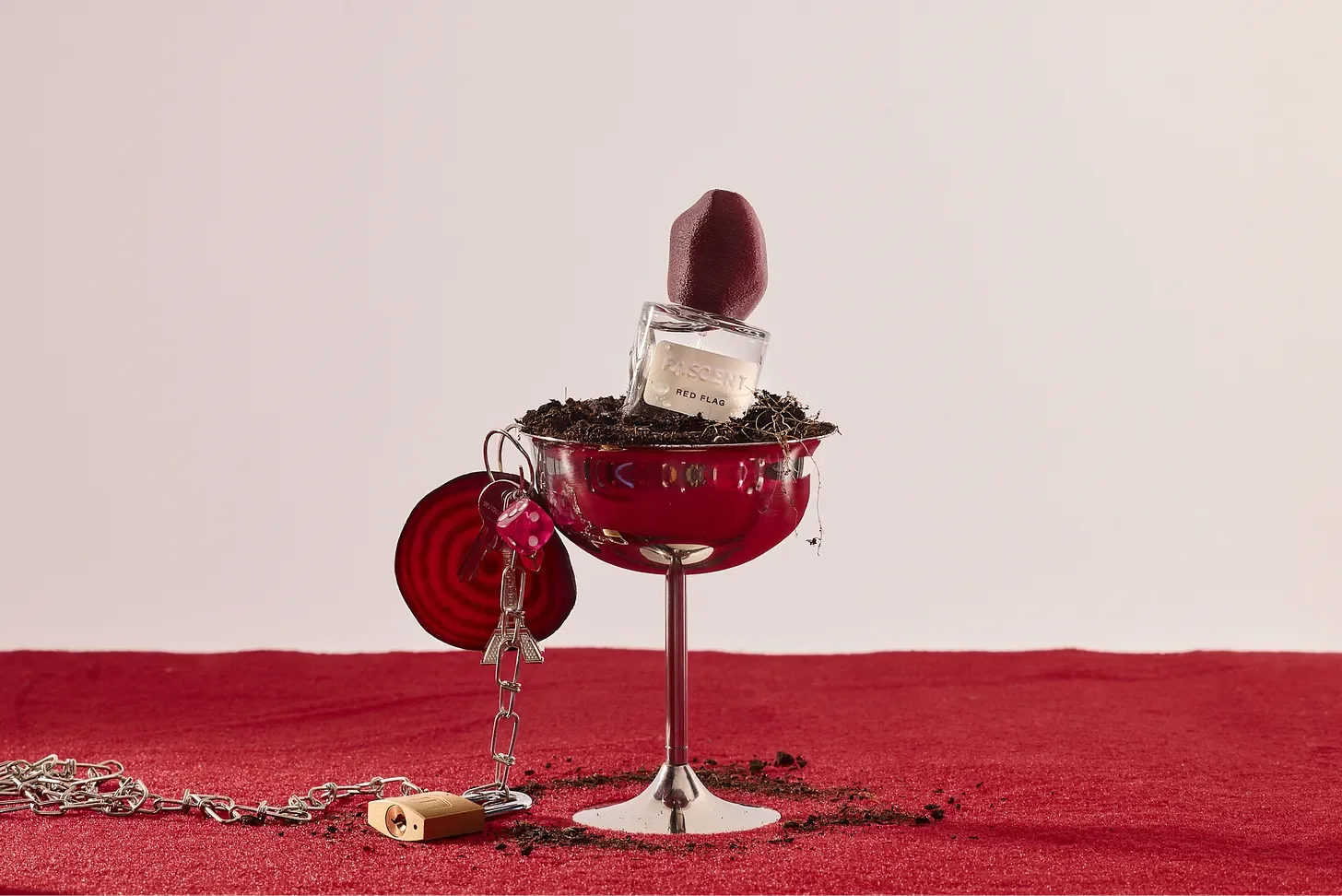
© Red Flag by Fascent
On a recent episode of The Fat Mascara Podcast, fragrance expert Thomas Dunckley talked about how GLP-1 medications aren’t just reshaping waistlines, they’re reshaping what we want to smell like.
As appetite-suppressing drugs blunt cravings and change the way millions of people relate to food, the heavy, hyper-sweet gourmand fragrances that ruled the last several years are starting to lose their pull.
Dunckley’s theory is that perfumers are following the appetite, not just the aesthetic, moving toward more unusual, savoury, or nuanced food-inspired notes: steamed rice, warm spice, smoke … Less ‘does this smell like dessert’ more ‘does this smell like something you’d actually want to eat’.
The shelf is already proving it. Perfumers are pulling in two directions at once, both away from straightforward sugar. One is toward texture rather than taste: beauty writer Sofie Albrecht recently mapped the rise of ‘lactonic’ perfumes for Feeling magazine. Scents built on the milky, velvety character of ingredients like sandalwood, musk and tuberose. They don’t taste like dessert so much as feel like one. You get the sensation, minus the sugar.
The other direction is toward the vegetable garden: in a separate piece, Albrecht traces how Hermès, Maison Francis Kurkdjian and Bottega Veneta are all releasing scents built on tomato leaf, fennel and artichoke. Fresh, slightly bitter and deliberately unsweet.
Neither trend cites GLP-1 as the reason, but both point in exactly the direction Dunckley’s theory predicts.
2. The reformer-to-golf shift
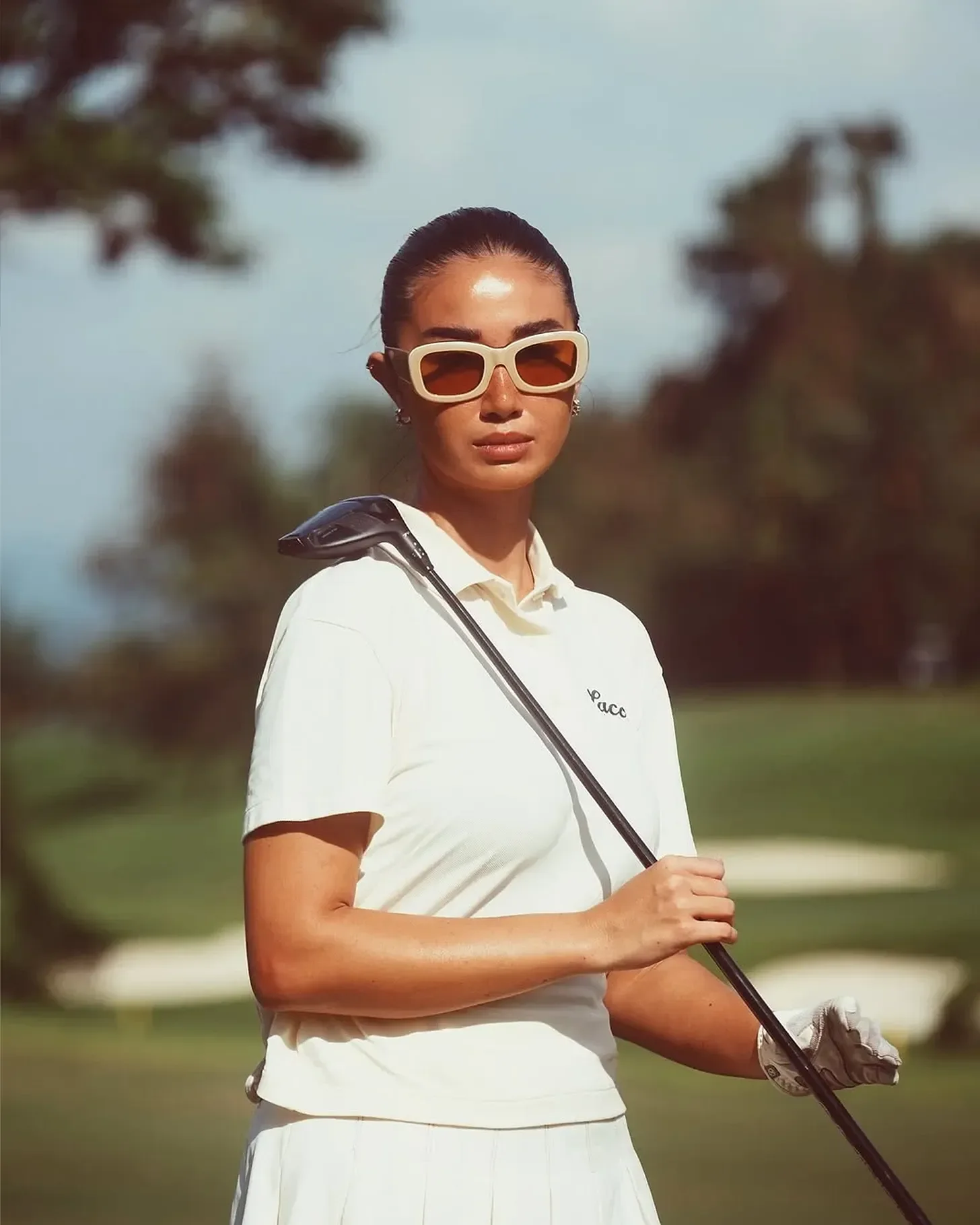
© Amateur golfer Savannah Gowarty wearing a knitted polo from Loro Piana
Pilates had a good run. But this year, golf is having its cool-girl moment. The numbers back this up: women’s golf participation in the US is up 45% since 2020, with 36 million women now playing worldwide. And, according to Studio Beyond, this boom is being built by the players themselves, not by any brand pushing it.
Part of what’s driving the shift is simple, as Studio Beyond points out: Pilates offers a workout, but not the human-to-human connectivity a generation raised online is actively hungry for. You can’t have a real conversation on a reformer machine or mid-downward-dog. A round of golf, by contrast, is three to four hours of walking up to 10 kilometres, fresh air, and uninterrupted time with friends, functioning as both cardio and a moving meditation.
It’s less a replacement than a reshuffle. “You go to Pilates, you get your matcha, then you go and play golf,” says Russell Winfield, creative director and sportswear designer.
Beauty has noticed the shift too. According to BeautyMatter, searches for ‘golf aesthetics’ are up 630% year on year, ‘golf skincare’ up 2,300%, ‘golf makeup’ up 1,600%.
Supergoop! has moved fast on this shift, becoming the PGA Tour’s official sunscreen partner through 2030 and rolling out a Reapplication Station at tournaments. CMO Lauren Weinberg puts the ambition simply: “If reapplying SPF becomes as routine as grabbing your glove or teeing up your ball, we’ll know we’ve succeeded.” PGA Tour Senior VP Alan Fish sees it as the sport catching up to where people already are: “People today are more focused on health, longevity, performance, recovery, and overall well-being than ever before.”
3. The neuroscience of awe
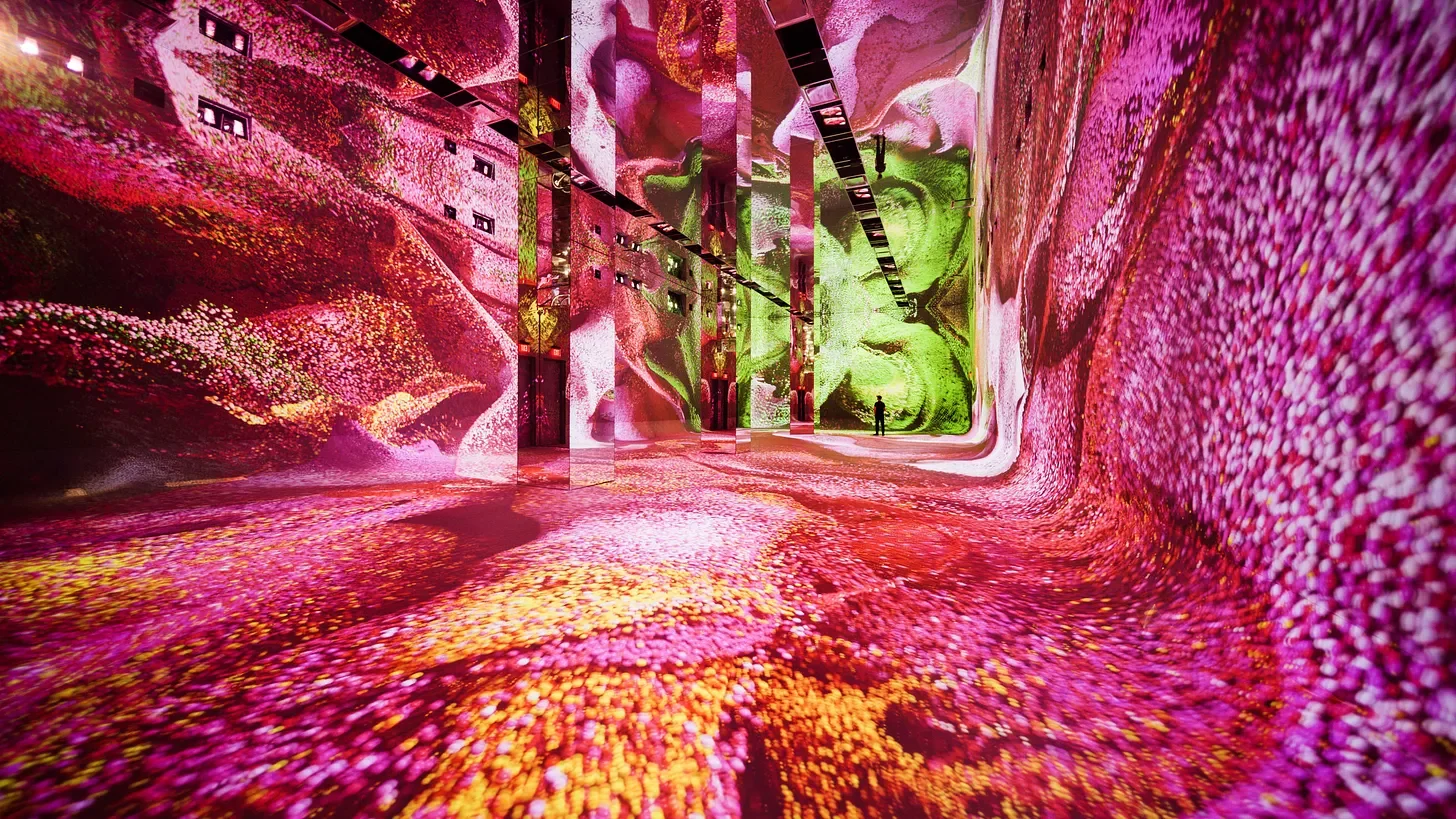
Data Pavilion: Installation view of Machine Dreams: Rainforest, DATALAND, Los Angeles (June 20, 2026 – January 31, 2027). Photo: Refik Anadol Studio. © 2026 Refik Anadol Studio on behalf of DATALAND
For a decade, immersive art was being dismissed as spectacle for the Instagram grid. That reputation is being dismantled from the inside, by institutions building art that responds to your body.
DATALAND, the art-and-technology institution founded by AI artist Refik Anadol, opened Machine Dreams: Rainforest in Los Angeles this summer, running through January 2027. Visitors wear biometric devices and the generative visuals shift in response. VML calls it ‘a machine dream that is not pre-programmed, but a living dialogue between art and the audience’.
Meanwhile the wellness world is discovering that the same technology, aimed differently, has a clinical use. Submersive - part-bathhouse, part-art-museum, part-wellness-destination - opens in Austin later this year; founded by Corvas Brinkerhoff, co-founder of arts production company Meow Wolf. Grounded in neuroaesthetics, it’s built to draw visitors into specific measurable states such as awe, wonder, transcendence … through biometric sensors and adaptive environments layered with light, scent, sound and temperature.
In London, wellness consultancy White Mirror and art collective Marshmallow Laser Feast built Lupuna, an Amazon forest-bathing installation for a German spa group. Their own neuroscience lab reported 81% of visitors felt measurably less anxious afterwards. And the Barbican’s Feel the Sound exhibition made the same case through sound alone last summer: Jan St Werner’s Vibraceptional Plate let visitors feel resonance through their feet, Robyn Landau’s Your Inner Symphony fed heart rate and skin conductivity into a shared display called The Well.
I felt it myself this summer, at the Holy See’s pavilion at the Venice Art Biennale. The Ear Is the Eye of the Soul, curated by Hans Ulrich Obrist and Ben Vickers, is built around Saint Hildegard of Bingen’s idea that listening is a form of contemplation. More than thirty contributors, from Brian Eno to FKA Twigs to Jim Jarmusch, turned two Venice locations into what the curators call a living archive of sound. No biosensors, no neuroscience lab logging anxiety levels. I wasn’t prepared for how physical it would feel but Patti Smith’s piece moved me to tears. Nobody measured what happened in my body, but if they had, I’m certain they’d have found a nervous system, briefly, at rest.
4. The camera you can’t see is still watching
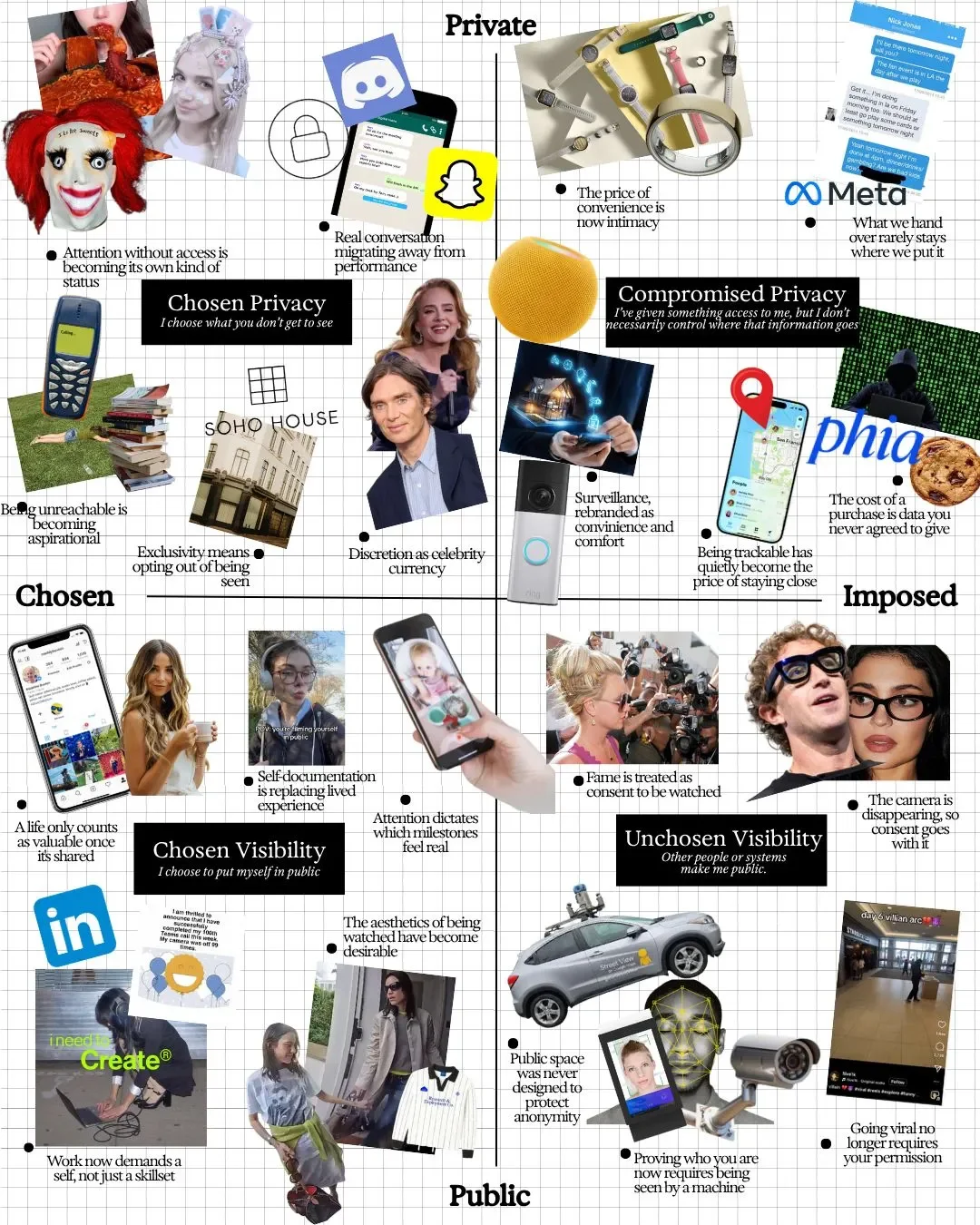
© Sibling Studio
Apple's next iPhone event is set for September 9. One of the leaks doing the rounds, though, is about camera-equipped AirPods, spotted in leftover code, Macworld reports. The cameras don’t record continuously (they scan what’s in front of you and let Visual Intelligence answer questions about it). In the leaked video, someone scans the title of a book, then asks Siri to save it for later.
It’s a small, practical feature. But a lens built to look at whatever’s in front of you doesn’t only look at books. This 'hidden camera' fits a bigger pattern. Doorbells film the street. Glasses are cameras now. Soon, earbuds too. Brand strategist Lucinda Bounsall wrote about this in a recent LinkedIn post; about a woman who found out, only after the fact, that a stranger in Meta glasses had filmed her, the video already racking up thousands of views. As "We have less control over when we're seen, while being increasingly incentivised to make ourselves seen anyway."
It isn't just about how much we're watched anymore. It's about who gets asked first. Visibility used to be something you built up: followers, reach, all of it earned over time. What's new is quieter: getting seen without ever agreeing to it, by a device too small to notice, let alone check. Nobody asks before you go viral these days. Nobody asks before you're filmed, either.
Bounsall’s also refers to an essay by her colleague Nina Maria: that the ultimate luxury, in a world running out of unwatched space, might be having a life other people don’t get access to. And that’s why ‘unreachable’ is starting to sound aspirational again. Not because we’ve stopped wanting to be seen. Because we’ve noticed we don’t get asked anymore.